
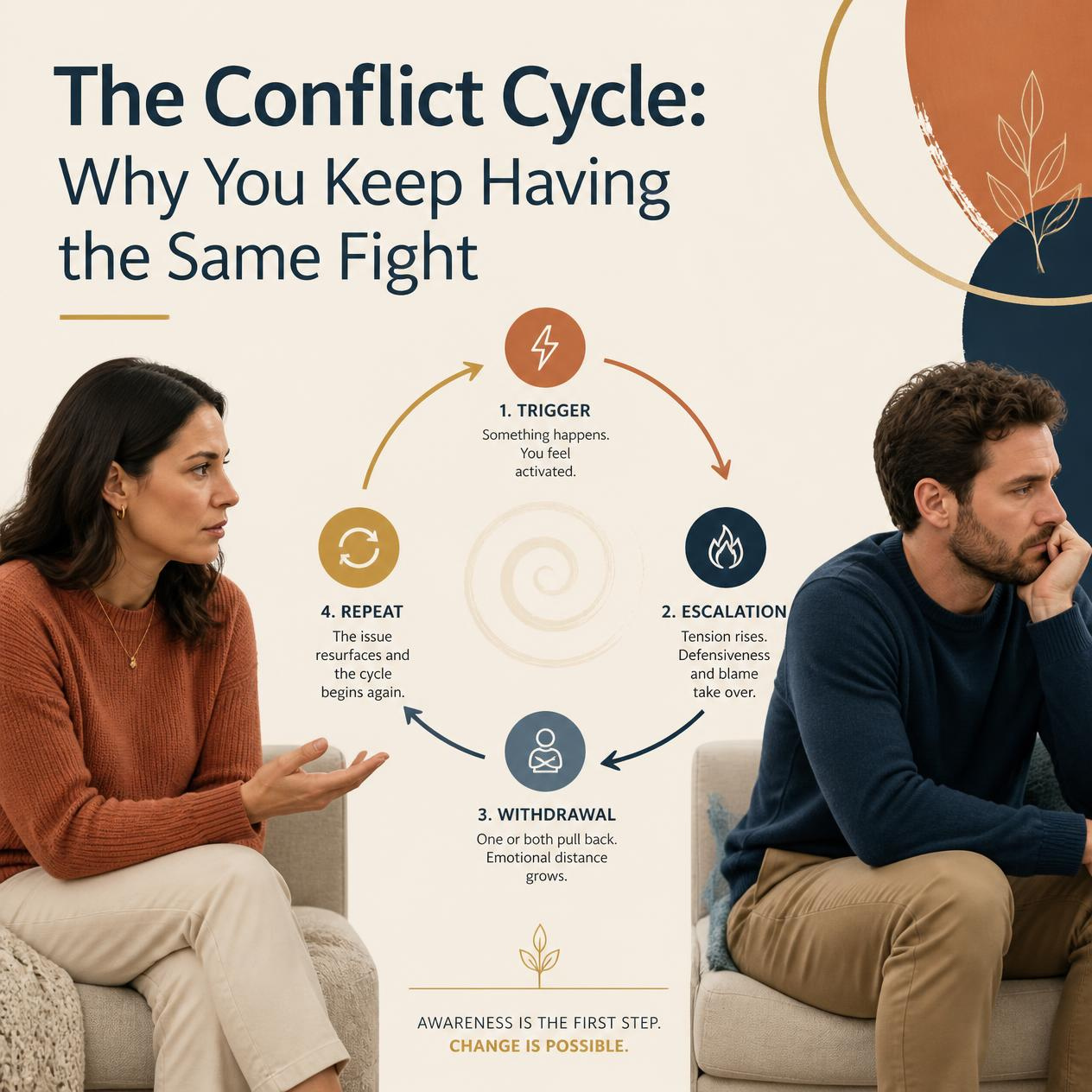
You promised yourself you wouldn’t go there again.
Not the same argument. Not the same tone. Not the same shutdown or blowup.
And yet, somehow, you’re back in it—repeating a fight you could swear you’ve already had a hundred times. Maybe it starts with something small (dishes, a text not returned, money, intimacy, parenting). But it escalates into something bigger: You never listen. You don’t care. I’m always alone in this. Nothing I do is good enough.
If you feel stuck in a “same fight, different day” loop, you’re not alone—and you’re not hopeless. Recurring conflict is usually not about a lack of love. More often, it’s about a predictable pattern fueled by stress responses, unmet needs, and the meaning each person is making in the moment.
Let’s name what’s happening: you’re caught in a conflict cycle.
What Is a Conflict Cycle?
A conflict cycle is a repeating pattern of interaction between two people—often triggered by something minor—where both parties react in ways that unintentionally intensify the tension.
It typically includes:
A trigger (something that sparks discomfort)
A story (the interpretation your brain assigns to the trigger)
A stress response (fight, flight, freeze, fawn)
A protective behavior (criticizing, withdrawing, controlling, defending)
A counter-response (your partner reacts to your protection)
A painful outcome (disconnection, resentment, shame, loneliness)
A confirmation belief (“See? I knew I couldn’t trust you.”)
The cycle is powerful because it becomes familiar. Your nervous system learns, “This is what happens here,” and it starts reacting before you’ve even fully thought through what’s happening.
Key insight:
Most couples aren’t fighting about the topic. They’re fighting about the cycle.
Why the Same Fight Keeps Happening
1) You’re arguing about symptoms, not the deeper need
The surface issue (time, chores, tone, finances) is often a signal pointing to something deeper:
Need for respect
Need for safety
Need for partnership
Need for rest
Need for reassurance
Need to feel chosen, valued, secure
Example:
One person says, “You’re always on your phone.”
Underneath might be, “I miss you,” or “I don’t feel important,” or “I feel alone.”
When the deeper need isn’t named, the argument stays stuck at the symptom level—and returns again and again.
2) Your nervous system is leading the conversation
When you feel threatened—emotionally or relationally—your body responds as if you’re in danger. That can look like:
Fight: criticizing, lecturing, raising your voice, sarcasm
Flight: leaving the room, avoiding, “I’m done”
Freeze: going blank, shutting down, silent
Fawn: appeasing, people-pleasing, “Fine, whatever you want”
In those moments, it’s difficult to listen, empathize, or problem-solve because your brain is prioritized for survival, not connection.
3) Each person is protecting themselves—just differently
One person’s protection might look like pushing for a conversation right now. The other might protect themselves by withdrawing.
This is one of the most common patterns:
Pursuer: “We need to talk about this!”
Withdrawer: “Not this again.”
The pursuer experiences withdrawal as abandonment or indifference.
The withdrawer experiences pursuit as criticism or control.
Both are trying to feel safe. Both end up feeling misunderstood.
4) Old wounds get activated
Sometimes the intensity of the fight doesn’t match the moment because the moment is activating something older:
Past betrayal
Childhood neglect
Previous relationships
Shame from earlier failures
Unresolved grief or loss
When those old wounds are touched, the present conflict becomes the stage where past pain is replayed.
5) You’re not repairing after conflict
Even healthy couples argue. The difference is whether they repair.
Repair is what says:
“I still choose you. We’re okay. We can come back together.”
Without repair, resentment accumulates. Each new fight carries the weight of the last ten—and the cycle strengthens.
The Conflict Cycle in Real Life (A Common Example)
Trigger: One partner is running late (again).
Story: “I’m not a priority.”
Stress response: Fight.
Protective behavior: Criticism: “You’re so inconsiderate.”
Counter-response: Defensiveness or withdrawal: “I can’t do anything right.”
Outcome: One feels alone; the other feels attacked.
Confirmation belief: “This is why I can’t rely on you.” / “This is why I shut down.”
Notice: the cycle is not about lateness. It’s about importance, respect, and security.
How to Break the Cycle (Without Winning the Argument)
Breaking the cycle does not start with better comebacks. It starts with slowing down enough to recognize what’s happening—then choosing a different response.
Here are practical steps that help.
1) Name the cycle as the enemy (not each other)
Try language like:
“I think we’re in our pattern again.”
“This feels like the same loop.”
“Can we pause and figure out what’s happening underneath?”
This shift matters because when you identify the cycle, you stop treating your partner as the opponent.
2) Locate your trigger and your story
Ask yourself:
What exactly triggered me?
What am I telling myself it means?
What am I afraid will happen?
What do I need right now?
This is emotional leadership: taking ownership of your internal experience before demanding change from someone else.
3) Regulate before you communicate
If your body is activated, your words won’t land well—even if you’re “right.”
Try a brief reset:
60 seconds of slow breathing (inhale 4, exhale 6)
unclench jaw/shoulders
lower your voice on purpose
take a short break and agree on a time to return (“Let’s talk in 20 minutes”)
If you need a break, include reassurance:
“I’m not leaving you. I’m calming down so I can talk well.”
4) Speak from vulnerability, not protection
Protection sounds like:
“You never…”
“You always…”
“Here you go again.”
Vulnerability sounds like:
“I felt dismissed.”
“I got scared we weren’t okay.”
“I need reassurance that we’re on the same team.”
“I’m overwhelmed and I don’t know how to ask for help.”
Vulnerability disarms. Protection escalates.
5) Make a specific request
Complaints are vague. Requests are actionable.
Instead of:
“You don’t care.”
Try:“Could you put your phone away for 15 minutes after dinner so we can connect?”
Instead of:
“You never help.”
Try:“Can you handle bedtime on Tuesdays and Thursdays?”
Clear requests reduce mind-reading and increase teamwork.
6) Practice repair (even if the issue isn’t solved yet)
Repair phrases include:
“I’m sorry for my tone.”
“I can see how that hurt you.”
“I’m on your side.”
“Can we start over?”
“Thank you for staying in the conversation.”
Repair restores safety. Safety makes problem-solving possible.
A Faith-Based Lens: What Conflict Often Reveals
Conflict has a way of exposing what we’re trusting in for security—control, being right, approval, comfort, or self-protection. Scripture consistently calls us to a different posture: humility, patience, honest speech, and peacemaking.
Two grounding reminders:
Be quick to listen, slow to speak, slow to anger (James 1:19).
This is not passive. It’s emotionally mature and spiritually wise.A gentle answer turns away wrath (Proverbs 15:1).
Gentleness doesn’t mean you ignore issues. It means you address them without escalating harm.
Faith doesn’t eliminate conflict, but it can reshape how we engage it—moving from “How do I win?” to “How do I love well and tell the truth?”
When the Cycle Needs Extra Support
Sometimes the cycle is strengthened by:
chronic stress
anxiety or depression
trauma history
unresolved betrayal
addiction
major life transitions
communication breakdown over time
If your conflicts include insults, intimidation, threats, or physical aggression, reach out for professional help immediately. In those cases, the goal is not just “better communication,” but safety.
Counseling can help you identify the cycle, slow it down, and rebuild trust—especially when emotions are high and patterns are deeply rooted.
A Simple Takeaway: The Fight Is a Signal
The same fight keeps returning because it’s trying to tell you something.
It’s pointing to:
a need that hasn’t been named
a fear that hasn’t been soothed
a wound that hasn’t been tended
a pattern that hasn’t been interrupted
You don’t have to keep repeating it.
Start small: notice the cycle, regulate your body, speak from vulnerability, and practice repair. Over time, those small choices create a new pattern—one marked by clarity, safety, and connection.
If you’d like, tell me the most common “same fight” topic you keep having (time, money, chores, tone, parenting, intimacy, etc.). I can help you map the likely cycle and offer a few tailored scripts to interrupt it.
Ready to Break the Conflict Cycle?
If you’re tired of having the same fight and want support identifying your conflict cycle, improving communication, and rebuilding emotional safety, I’m here to help. Schedule an initial consultation by calling 443-860-6870 or book online here:
https://book.carepatron.com/Restoring-You-Christian-Counseling/Elisha?p=F869i2fsQCahi2s-K3afuw&s=6ZZMlbpB&i=XgXzcJJJ